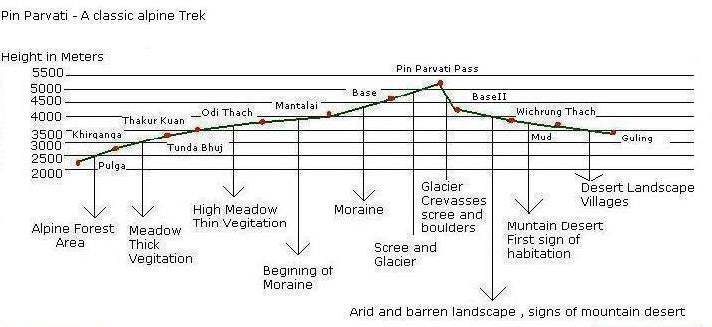
1st June – 13th June 2012
My friend Saad and I have been planning this trek for more than two weeks. Since all this planning is taking place when our exams are still going on, we are constantly fighting the urge to spend all the time devouring maps and reading more about the region and instead trying to focus on the exam syllabus. So, while most of our friends are frying their brains off to study for the last two tests, we are having wonderful and sometimes dreadful dreams about our upcoming adventure.
Both of us know the trek is very strenuous and our past experience does not match it. We have decided not to take any porters or a guide — seldom done on this trek. You can call it the arrogance of a young mind, but we wanted to be independent. It is your load and you should carry it. More importantly, we would be out of network coverage for at least six days, during which our family would get very anxious. This has been a source of serious tension at Saad’s house.
Day 1 — Delhi
Exams ended yesterday and it feels absolutely amazing to be out and travelling again. In spite of carefully planning our luggage, the bags are heavy and we have so much stuff that all of it cannot fit in the backpack. I already bought the bus tickets to Bhunter through the Himachal Road Transport website — that helps in avoiding the chaotic queues at the ISBT depot. We take the 9:15 PM bus from Delhi and hope to reach Bhunter after some 13 hours.
Saad has brought biryani, kebabs and kachoris for dinner, which we eat in the cramped bus. We have seats near the engine — the sound of which, accompanied by third-grade shockers, makes sleep a dream prospect. We still manage to sneak in a few minutes every now and then before the bus roars us back to reality. On the way, we make a list of all the things we have already forgotten at home: maps, an extra watch for Saad, whistles, water bottles.
Day 2 — Bhunter, Barsheni and Rudranag
Reached Bhunter at 11:30 in the morning and we are relieved the bus journey has ended. We take our luggage near an empty space in front of a shop — and Saad immediately realises we have forgotten our ice-axe on the bus. Some of the equipment has been rented from the Indian Mountaineering Foundation at Delhi and we supposedly paid Rs. 4,000 security for the axe. I cannot help but find this amusing.
Through the help of a very supportive traffic policeman we track down the bus, which has now reached Kullu. Leaving our backbreaking luggage at a local medical store, we take the bus to Kullu — triumph! According to that helpful policeman, in H.P. you get back 80% of your lost stuff.
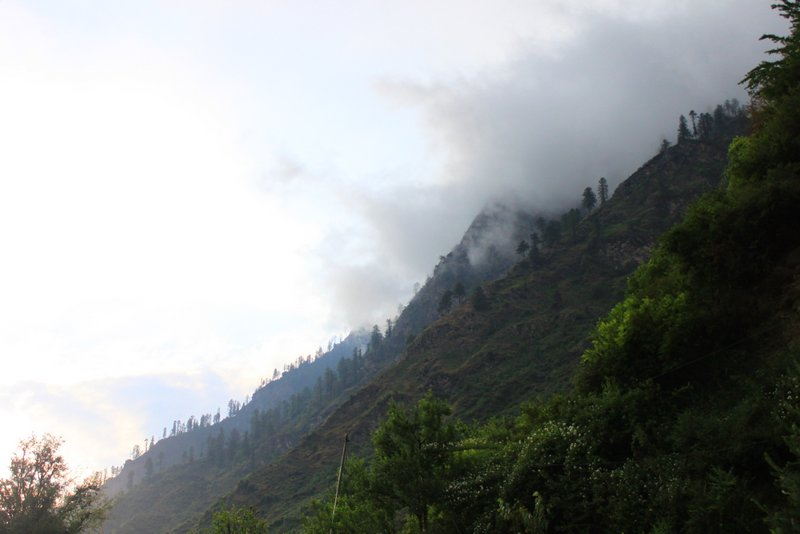
On the way to Barsheni
With renewed spirits we take another bus to Barsheni — the starting point of our trek, some 35 km from Bhunter. On the way, Saad realises we are also missing the solar panel meant to charge our mobile phones. Oh, what a dreadful day. We spend the next few minutes contemplating our mistakes and chalk out a strategy: stuff all loose luggage inside the backpack, and double-check everything before leaving any place.
As the bus zooms through the narrow road surrounded by dense coniferous forest, small mountain peaks start becoming visible and our gloomy faces lighten up. The cool wind and fresh air fill new vigor into me and I spend the next hour with my head out of the window enjoying the wonderful scenery. We pass Kasaul and Manikaran on the way, and during the last bit of the journey it starts raining heavily.
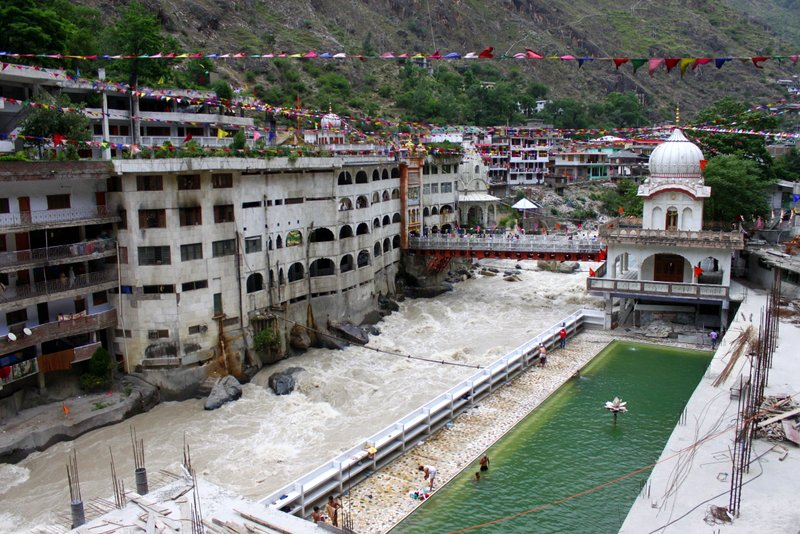
Manikaran
Barsheni greets us with a grim smile. It is cold and raining — not what we expected. Saad gives me a sharp look; I was the one who had given the thumbs up about the weather. We hastily take out our luggage and reach the nearest tea shop for hot tea. Some local touts immediately ask if we want to go to “Pulga” — we quietly ignore them. This region is a hotspot for foreigners, especially Israelis, many of whom come for cheap substances that locals sell openly since the police hardly ever visit.
A local person warns us that at this time of year, weather will deteriorate further up and trails will be covered by mud or snow. We completely ignore him.
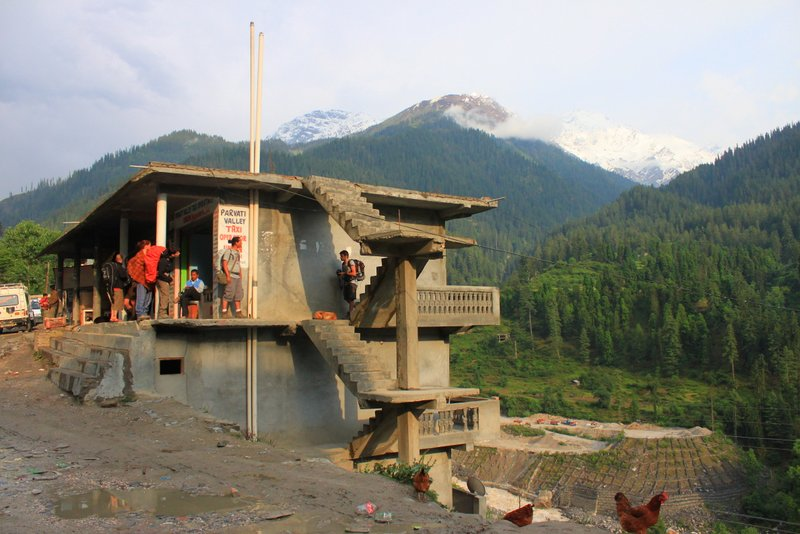
Barsheni
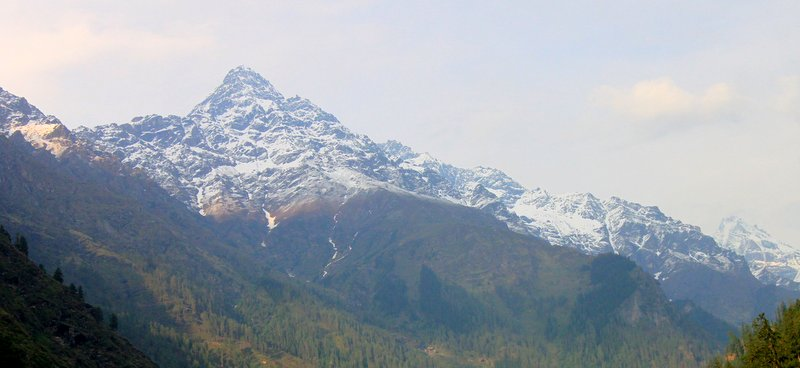
The Parvati Dam is being built at Barsheni — once complete, it will be the largest hydroelectric power plant in India at 2,500 MW.
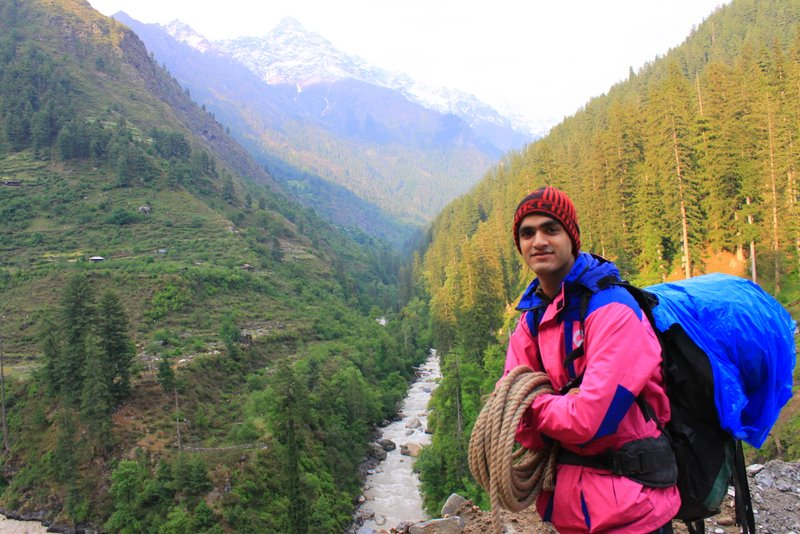
Saad
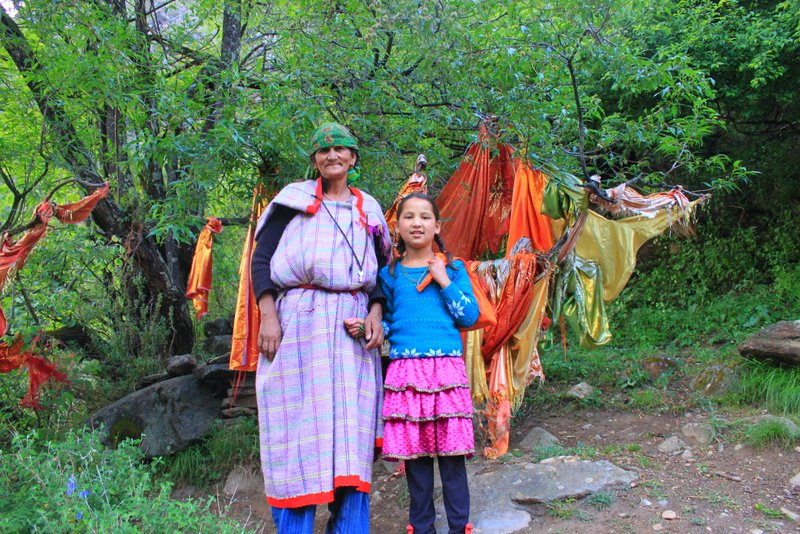
The first part of any trek is always tough. Saad’s backpack — heavier than mine and lacking good shoulder cushioning — has him complaining of shoulder pain. We plod along and look in dismay at the vanishing sunlight. Our planned destination, Kheerganga (around 12 km from Barsheni), cannot be reached today. We meet a local lady accompanied by her granddaughter who keeps us company, urging us to move steadily and encouraging us that the next village was not too far. Apparently this neat little trick works — we keep moving in spite of the pain and thirst.
The lady and her granddaughter — they tied a coloured piece of clothing near the tree for good luck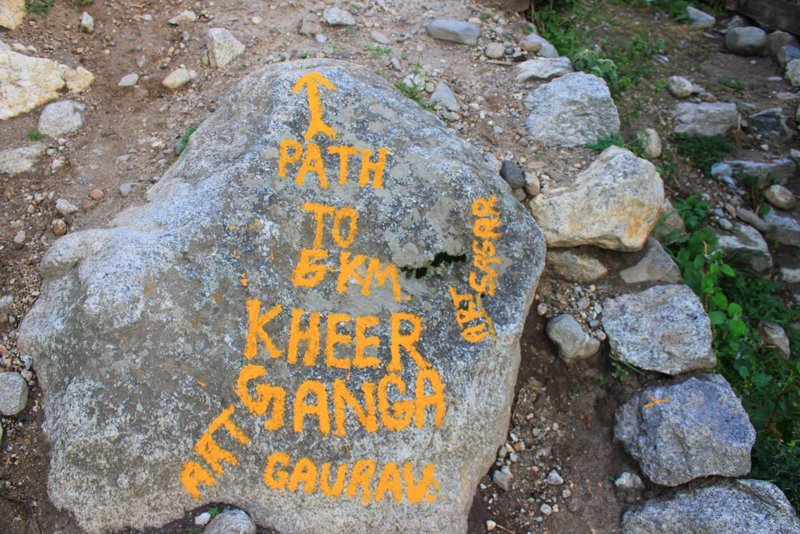
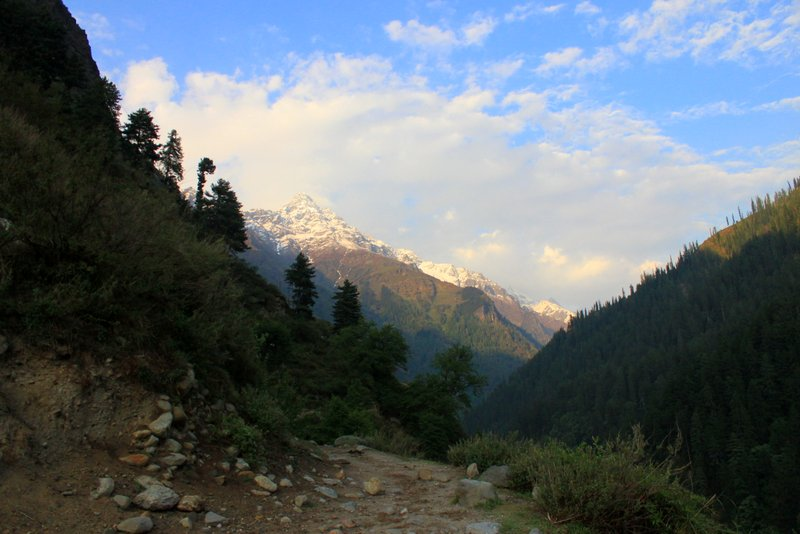
With the sun set and the path lit only by moonlight, we finally reach Rudranag at 7:45 PM. To our surprise, a local priest offers us an extremely spacious and warm hut for the night.
About Rudranag: The name translates to Shiva’s Snake — a King Cobra — and comes from a nearby waterfall shaped like a serpent. A small temple to Lord Shiva stands here. Trekkers can use the hut free of charge.
We light the stove and make potatoes and rice, then sit under a blanket of stars with the moon radiating through the coniferous trees. The sweet rumble of the waterfall in the distance. It feels heavenly. We talk long into the night, planning tomorrow, reliving the day’s events. At 11:55 PM we call it quits and fall into a deep slumber.
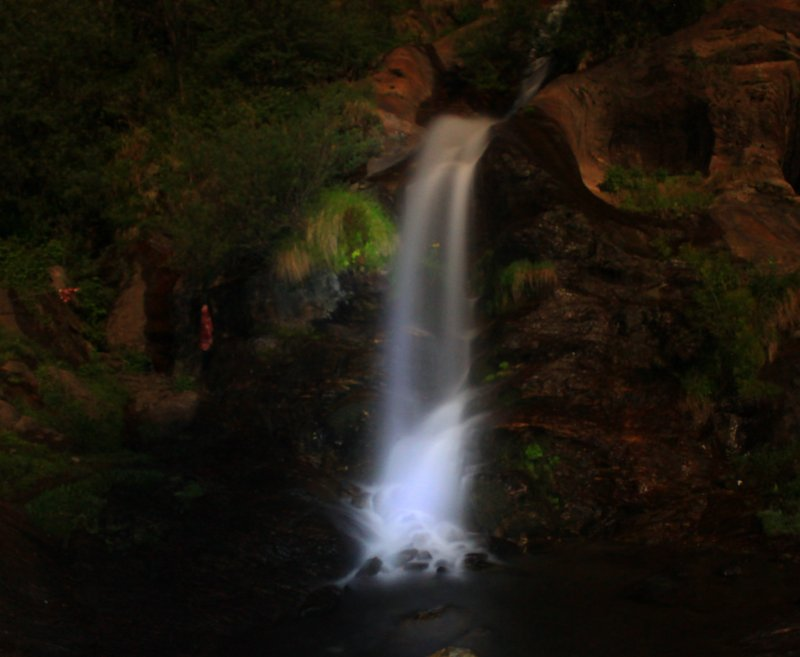
Waterfall at Rudranag
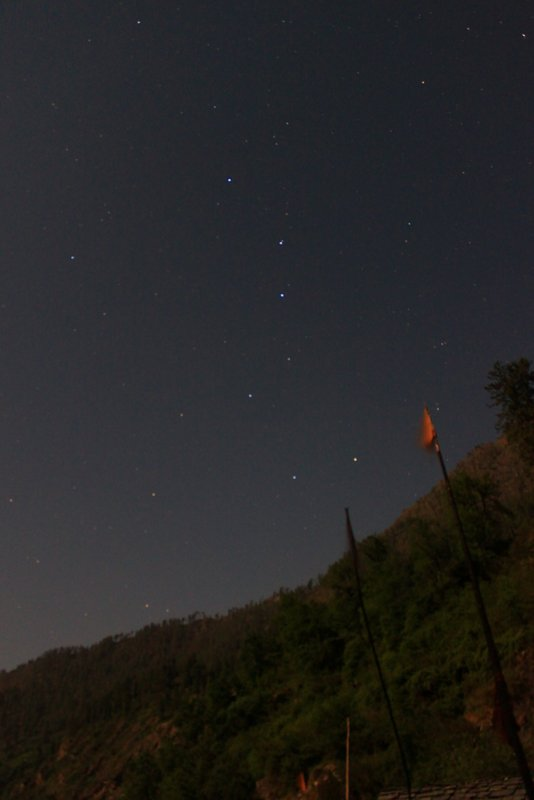
The Great Bear!
Day 3 — Rudranag to Kheerganga
The shining sun wakes me early. It is 5:30 AM. Saad still sleeps on. By the time we are done with packing, cleaning and double-checking, it is 7:30 AM.
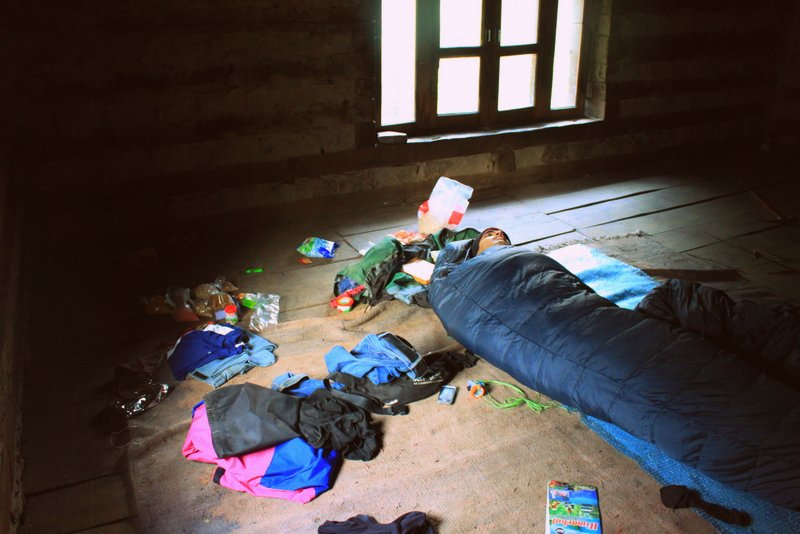
Saad sleeps on!
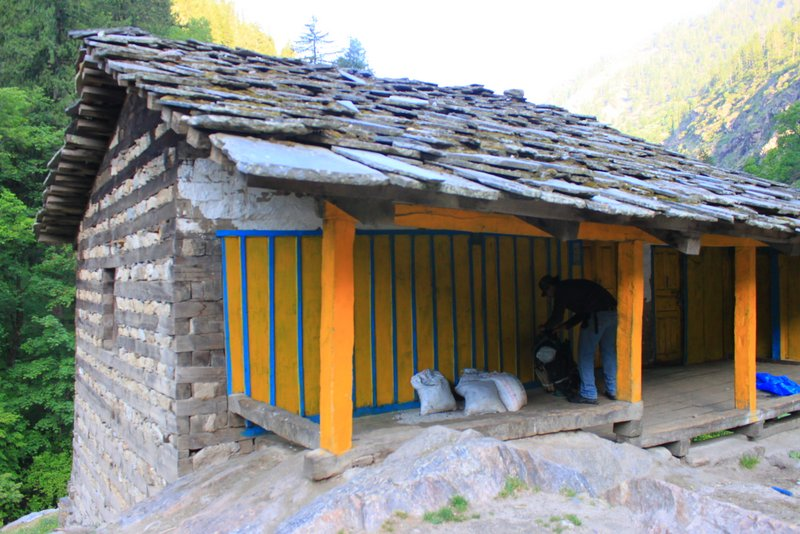
Goodbye, hut!
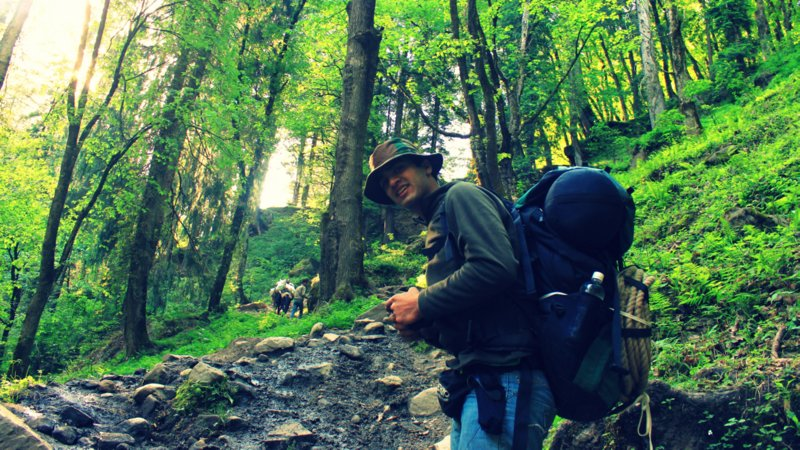
The ascent to Kheerganga from Rudranag is tough, mainly because of our heavy backpacks. The trail leads through thick coniferous forest. Birds are always with us through their calls and songs, though we cannot spot them. After what seems like eternity we reach Kheerganga at 10:30 AM — the foliage gives way to open meadows littered by boulders large and small. There are far more shops than we had imagined. You can get almost anything to eat and drink.
Mythology of Kheerganga: Kartik, son of Lord Shiva and Goddess Parvati, is said to have meditated here for over 1,400 years. One day he asked his mother for hot kheer (sweet rice pudding). Parvati accidentally dropped it on her way to him and, adamant to give the same pudding, magically made hot water spring from the ground — and the pudding was restored. This is how Kheerganga got its beautiful hot springs.
View from Kheerganga
Kheerganga sits on a slope, at the top of which is a small swimming pool in hot spring water. Separate pools exist for men and women. Adjacent is a Shiv temple.
Drenched with sweat, we spread our clothes to dry. To the north, formidable mountains rise and tiny streams pour down from them, coalescing into a large waterfall that is blown by the wind into a wave-like pattern as it falls from a cliff. I change into shorts and take a dip — the water is really hot.
At 12:45 PM we start for Thakur Kuan. The trail passes through cedar forest with the Parvati River roaring below on the left. Near 2 PM we meet two people — Suresh and Chandra — whom we had briefly encountered at Kheerganga. Suresh tells us he and many others from Himachal are collecting a herb called Nag-arjun, valued in China at Rs. 10,000 per kg and now banned by the government. “The more hands you have, the better,” he says, without a trace of concern.
Suresh extends his hospitality, inviting us to dine with his group that night. On hearing our plan to cross the Pin-Parvati Pass (5,400 m), he shows great apprehension. At this season, he warns, the pass would be under too much snow and the trail to Mantalai could be lost entirely without a guide.
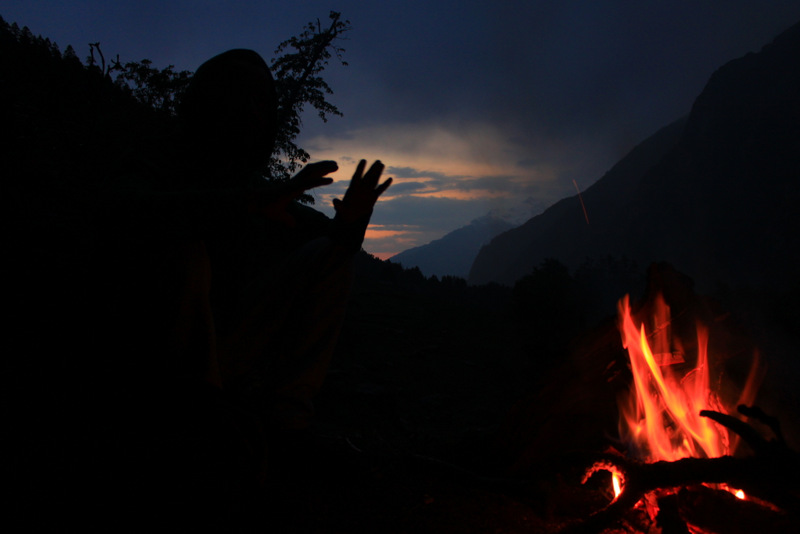
We reach their shelter — a man-made cave — and sit by the fire with hot tea. After a great length of talk and some silence, a breathtaking scene unfolds before us. The sun has set and yet the hues of yellow and orange have not left the western sky. The world suddenly looks very big, with its wide open spaces, black towering mountains and clouds mingling with the earth. Amongst all this grandeur we are nothing but silent witnesses — a spellbound audience watching the greatest show on Earth. It is wonderfully terrifying. We have fire, food and a cosy tent. Never in my life have I been more grateful for those things.
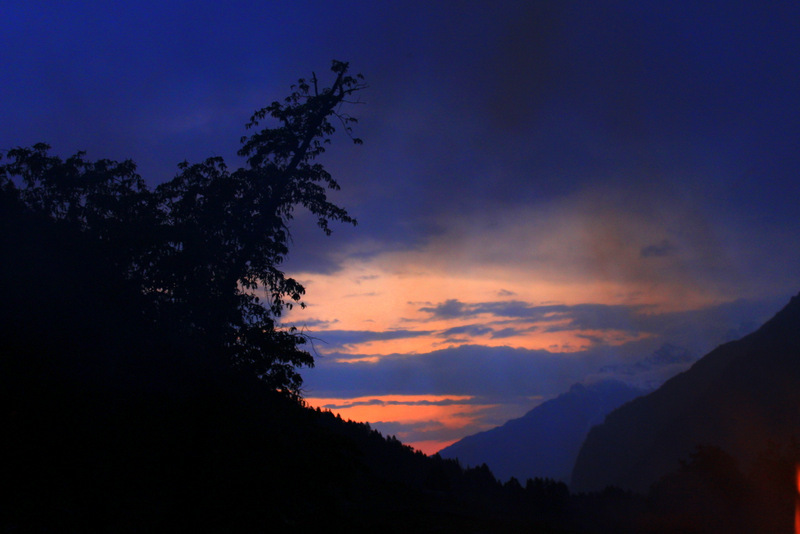
Day 4 — Somewhere between Kheerganga and Tunda Bhuj
With so many words of caution ringing in our ears, we decide to shorten our trip, terminating at Pandav Pull — a huge boulder used to cross the river bank. We take ration for only four days, leave extra clothing and the rope behind. The lighter bags are a welcome relief.
As we start walking, a stray dog accompanies us. We name him Milo and find he relishes rusks. He loves to lead, and often smells something and darts off into the forest before returning to the front.
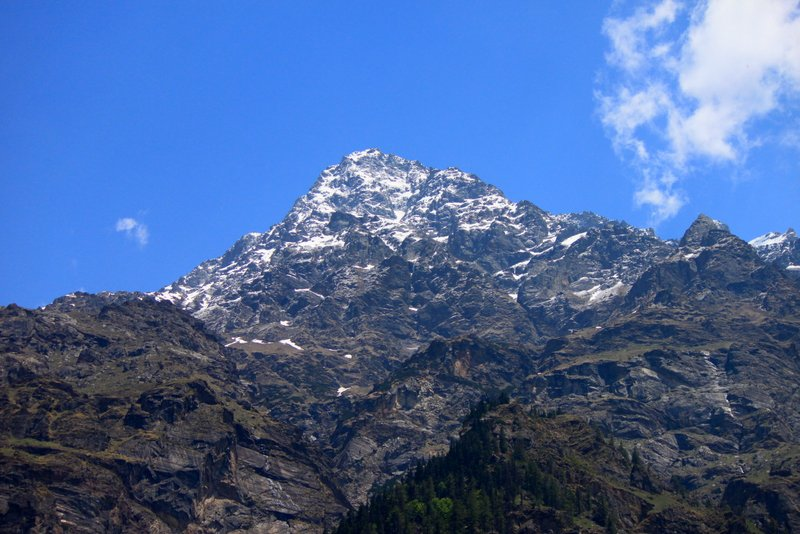
The trail alternates between tall coniferous forest and open meadows. Far in the distance, snow-capped peaks seem to vanish into the sky. In well-shaded areas, snow has not fully melted and copious water flows down into the tumultuous Parvati below. One set of peaks particularly fascinates me — three gloomy hunchback giants standing shoulder to shoulder, their black death-like appearance undiminished by the bright day.
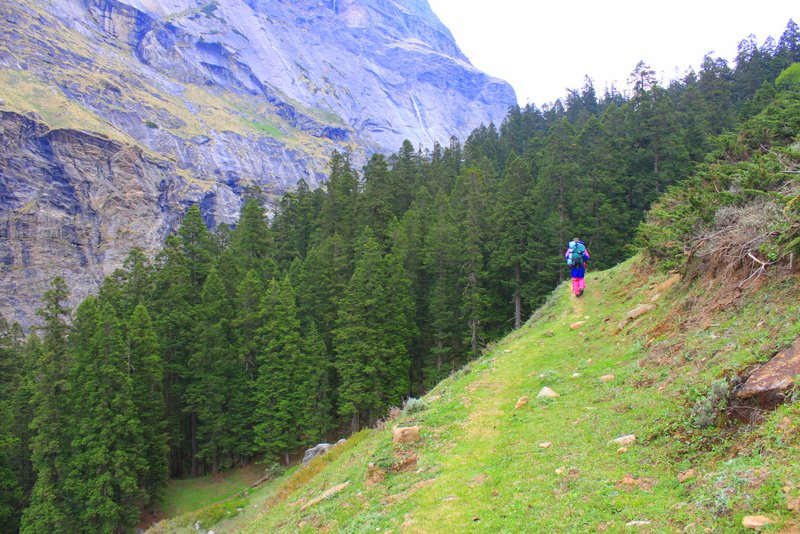
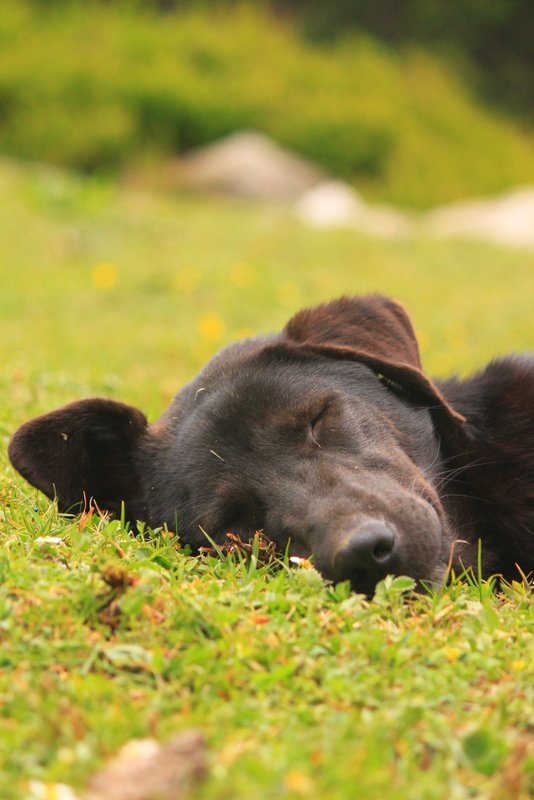
Around midday we reach Thakur Kuan — graffiti-laden broken wooden huts. A young shepherd tells us there is a camping place two hours ahead. Saad cruises ahead with Milo while I slack behind taking pictures.
The trail ahead is narrow but flat enough to see almost two kilometres of it. I spot a familiar tree called Bhujpatra, recognisable by its curved “S”-shaped trunk and pale bark that, when peeled, reveals a reddish layer. Long before paper was made from wood pulp, writings were done on this bark.
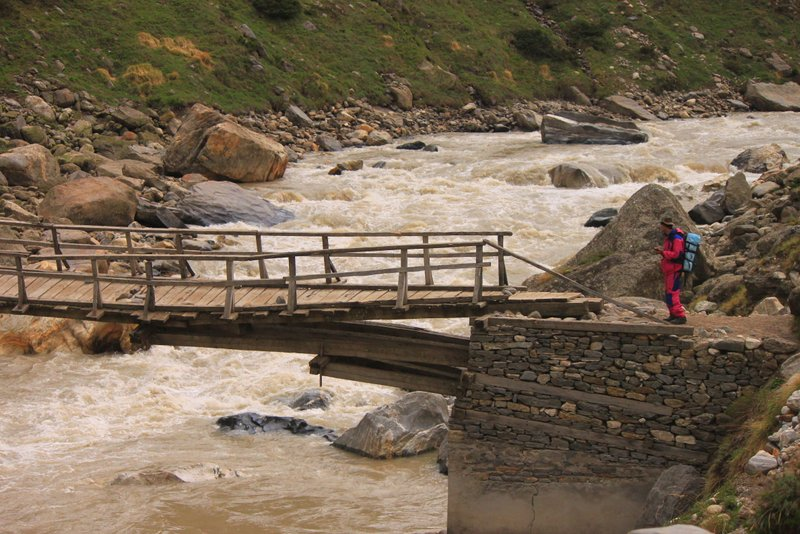
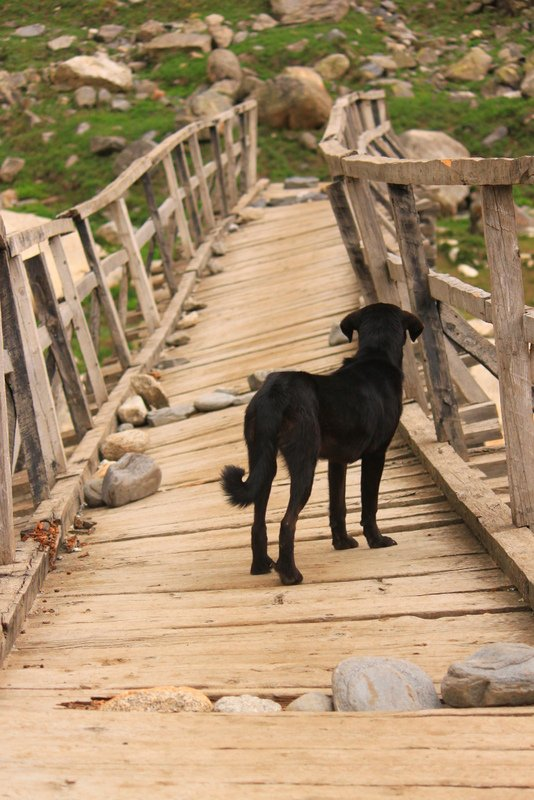
At 2:30 PM we spot a wooden bridge in deplorable condition, hanging by two inclined girders on either side. Milo hesitates and turns back even before crossing a quarter of the way. Saad crosses comfortably; I feel the bridge rock gently as I cross and notice a foot-wide gap clumsily covered by stones in the middle. We whistle and call to Milo but he roams around restlessly. Another dog appears on our side, barking at him furiously. With a heavy heart we abandon Milo and start the steep ascent.
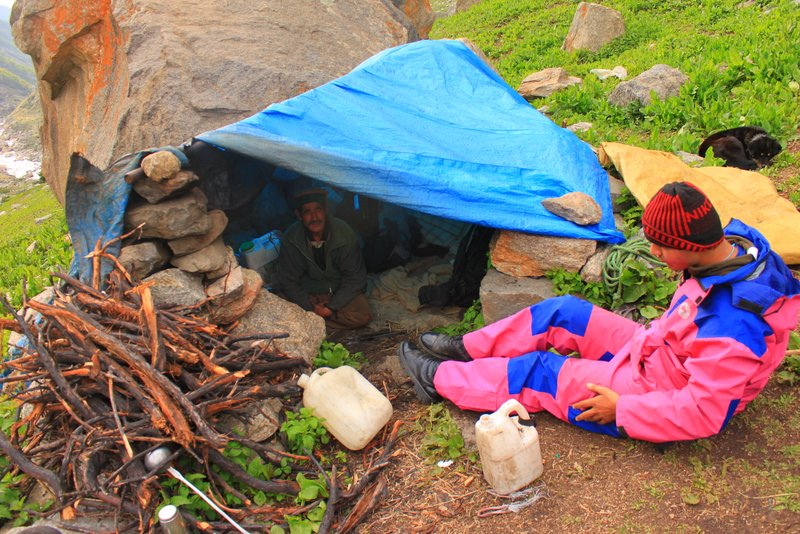
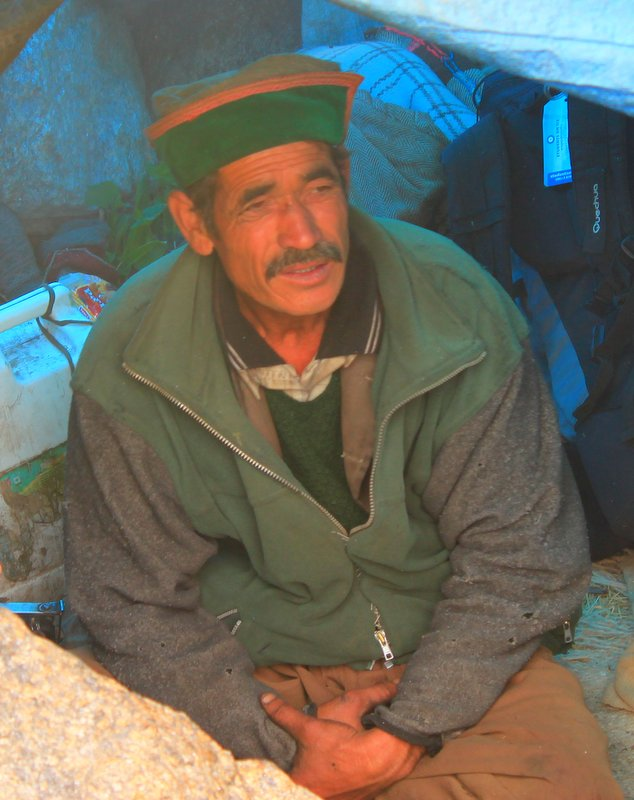
His whimpering stays in earshot for a long time — still trying relentlessly to find another way across. As I gaze up the path I see a thin man squatting with two dogs. By his attire I can tell he is a shepherd. He waves us up to his shelter — a dera — conveniently located behind a huge boulder, made from rocks shelved on three sides with a tarpaulin braced over the top.
“When I saw you coming from far,” he says, “I thought you both were foreigners” — pointing toward Saad’s fair complexion. “And then I saw you” — pointing at me — “and I knew you were fellow Indians.” A big smile that doesn’t lose its touch behind his thick moustache.
His name is Virchand and he reckons he is close to 55. He has spent half his life looking for greener pastures for his goat and sheep. “This is the only thing I know,” he says bluntly. “And since I am illiterate I have nowhere else to go.” Instead of the boundless joy I had assumed, there is a deep pang of regret in his voice. “But yes, over these years I have come to love these bitter-sweet mountains. I feel completely free here; nobody tells me what to do.”
For two hours we sip tea, eat dry fruits and biscuits, and discuss the difference between life in the city and life in the mountains. Saad and I try our hand at chopping firewood with a big C-shaped instrument — our repeated blows have little effect. Virchand grins so loudly it could be heard a mile away. We look at each other quite rightly embarrassed: “It looked so darn simple!”
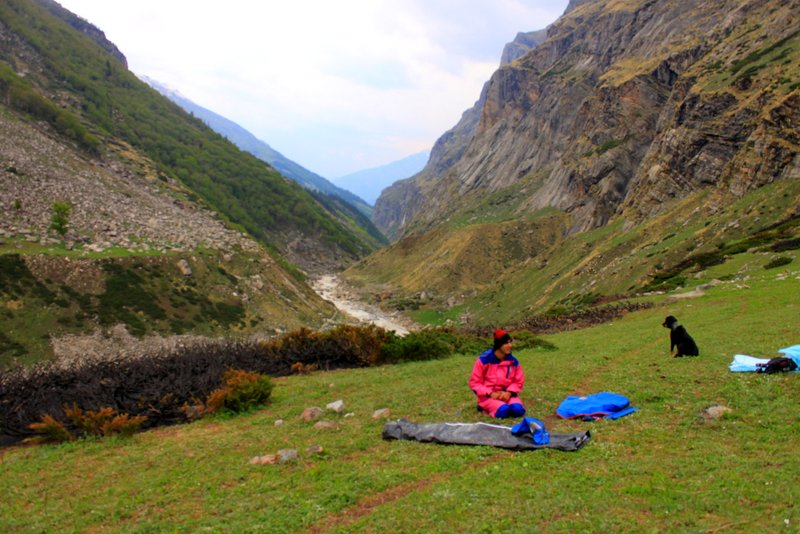
Our camping site. The burned bushes on the left — shepherds do this to reduce moisture in the wood so it burns better.
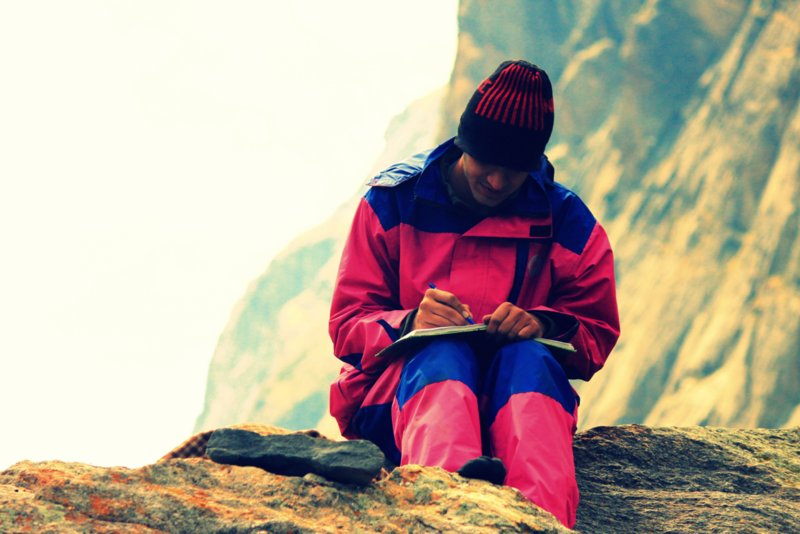
Saad, writing in his journal
As evening beckons, Virchand gathers all his goats and sheep from different parts of the mountain. These sure-footed creatures have absolutely no respect for their master — he points to a precipitous cliff where they are busily munching grass and spends a minute cursing before heading off with his stick, whistling and shouting.
Virchand’s arrival is heralded by a cacophony of a gazillion meehhhhhs. His two dogs trot alongside in the image of their master, heads and tails held high. After a flurry of activity — chasing strays, keeping them from the ration, milking — the day winds down. We take refuge inside his tent, wrapped in blankets woven of goat hair, hot tea in hand. There is no greater bliss.
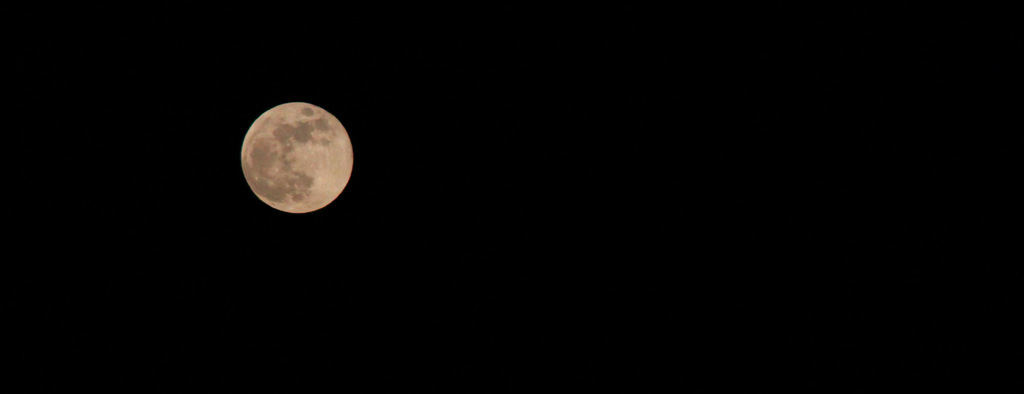
And then — very slowly and delicately — the moon, a full moon, rises up from the dead. All things black return some of their colours; all things alone now have their shadows. I have never seen such a charming sight. The flourishing shine spreads across the heavens and earth and everything living or dead seems enraptured, taking a quiet bow. Then the monstrous clouds sweep across the heavens and the show ends.
Saad and I retire to our tent while Virchand sleeps with his herd, out in the cold, with his fearless dogs keeping ravenous black bears at bay.
Day 5 — The Helipad Camp
Next day, the weather is immaculate. I head toward Virchand’s tent early. He is already awake, preparing tea. “Well,” he says, “heard the barking of the dogs last night? A bear came near the tent.” My jaw drops. “It was nothing really. He came and I scared him off with my stick. Never ever be afraid of a bear.”
Was scaring a 125 kg beast with four-centimetre claws as easy as it sounded? “Oh! You should have woken us up — we wanted to see bears!” “I thought so,” he replies, “but then you are city folks and you would have been scared shit.”
Since the next destination is close and we cannot walk beyond it today (no camping place after Thakur Kuan within a day’s walk), we start late. While Virchand is already off with his herd, we sit and write our journals. Then it starts raining profusely.
It takes another two hours before we say our final goodbyes to Virchand. He has been a great host. I take one last picture and promise to send it back.
The hike thereafter is gentle, with undulating slopes. Giant snow-covered mountains become visible and we trace the Parvati River to quite some distance before it disappears in a wide arc. After two hours of walking, we spot a rope bridge.
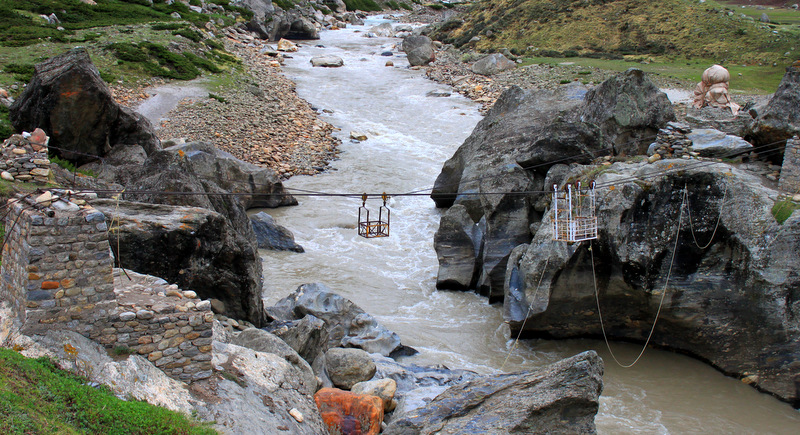
Our final destination is Pandav Pull — a bridge thought to have been constructed by the Pandavas. The area near it is a chaotic display of broken pumps, iron pipes and plastic fibre from now-disembodied huts. A sad sight.
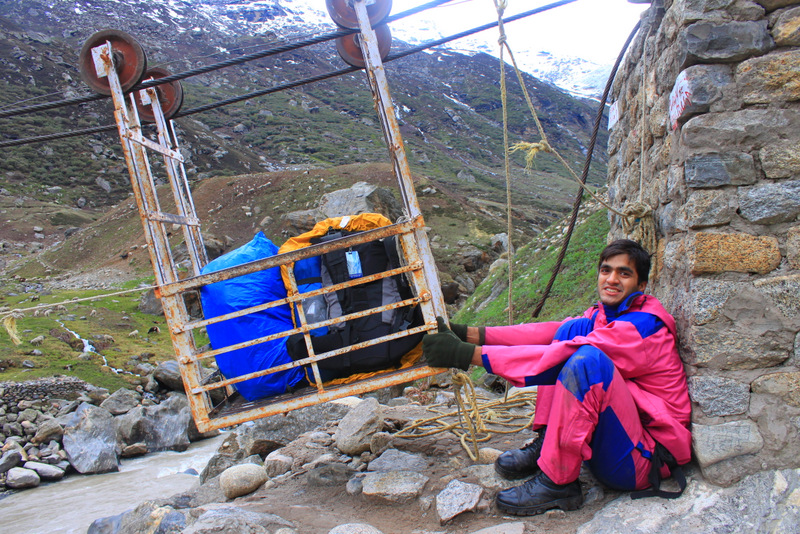
We pull a white steel trolley toward ourselves from the ledge. The other one is broken. There is enough space for both of us with bags, but the left tower is higher than the right, and we cannot find a way to tie the rope to it. Finally, as Saad holds the trolley, I get in with the bags and he lets gravity take over. Just then — SNAP. The rope connecting Saad to the trolley breaks. I am hovering over the middle of the tormenting river.
I try to pull myself across. I fail the first attempt. I succeed the second. With one hand holding the trolley from sliding away and the other lifting backpacks out of it, the work is exhausting. Somehow, I crookedly tie the rope to a rock so the trolley cannot slide off. Meanwhile, a panicked Saad moves along the river bank looking for another crossing.
I find the nearby shepherd, Keval, but upon seeing the situation he has no clue what to do and excuses himself — his cattle need gathering, dusk is approaching. The only thing he points out is the state of the ropes, so worn they look like dying animals. We hadn’t noticed.
I climb back into the trolley and reach the midpoint — the maximum gravity can take me. I tell Saad to tie the broken rope to a stone and fling it to me. Neither is he able to get the rope onto a stone nor is he confident it won’t hit me. Through some sheer ingenuity, Saad grabs the hanging rope from the trolley by standing on the rock below the left tower, and — to cut things short — we reach the other side safely.
We set up camp on a dilapidated helipad near Keval’s tarpaulin tent. This short but adventurous day has come to an end.
Day 6 — Thakur Kuan (Stranded by Rain)
I wake to the feeble pitter-patter of rain on the tent. 5:30 AM, 3.8°C. I make tea in a makeshift kitchen covered by large flat plastic tiles from the surrounding rubble. Saad writes his journal in the tent while I head to Keval’s hut to gossip.
He tells me this helipad was built when a canal was being dug to divert water from the Parvati. The geologists eventually found a mountain so loose that tunnelling through it was impossible and the whole project was abandoned. As he sniffs his bhang, he narrates tales of people killed on this trek — some engulfed by crevasses crossing the pass, others who slipped at Pandav Pull. “These mountains are bleak, unpredictable and unforgiving. I have spent close to thirty years on them.”
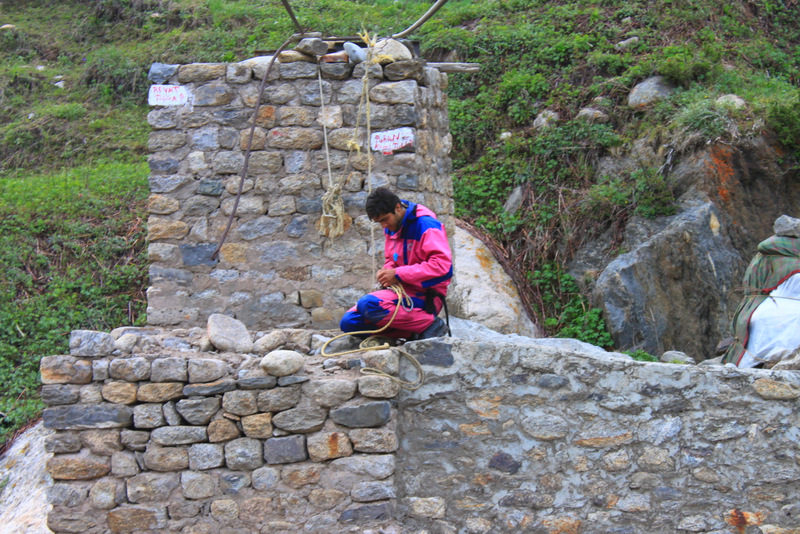
“When I was young,” he continues, “the mountains were all ours to conquer. We used to run on these very mountains on which you scamper in pain and exhaustion.” I sense his distress comes not from a changed relationship with the mountains but from changed bodies. The curiosity is not gone — it is the body that no longer keeps pace. The curses that flew from their lips with power and courage now take the shape of weak shrieks from a frustrated frame.
As I sit closer to the fire, I find myself thinking about my own fascination with the wilderness. These pinnacles of rock with their devilish heights are an intimidating calling — as if one has seen a beauty so powerful and unearthly that even for all the danger it proclaims, we are driven toward it.
There have been thousands of people like me for whom the wilderness represents a gateway — an entrance to a world of peace, enlightenment and freedom. The ancient scholars believed that the higher one goes, the faster the process of enlightenment. But the wilderness does not govern by your principles. It is unpredictable, majestically dangerous and utterly indifferent.
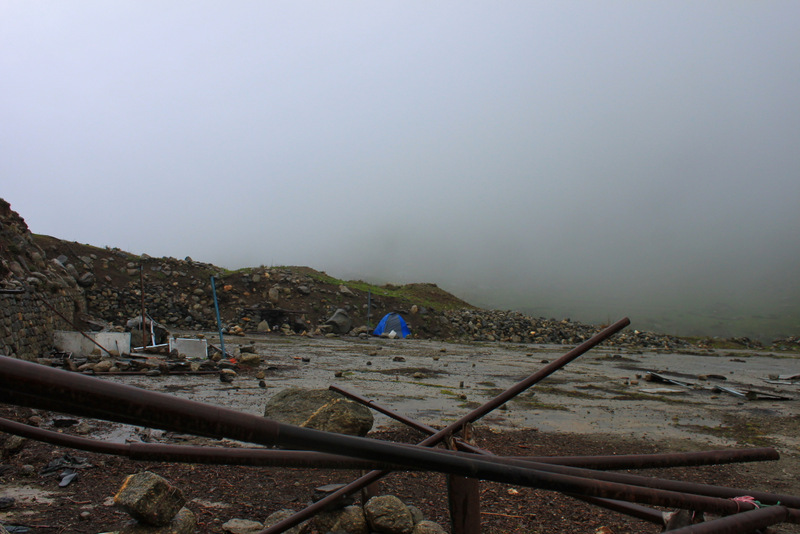
Time slogged. It was just 10:30 AM. While Keval checked on his herd, Saad emerged from the tent and immediately rushed to the fire. “Bloody cold,” he muttered. I patched up Keval’s shelter, stretched out the tarpaulin to drain its water dam, fashioned a bench from plastic sheeting. Saad fiddled with the fire and quite magically managed to extinguish it. Keval came in surprised, chided us amusingly, and in another minute the warm glow had returned. In the cold, fire is life.
Day 7 — Towards Mantalai
The glorious sun welcomes us as we step out of the tent. Keval and a friend are chatting nearby. Over hot tea, both urge us to push beyond Pandav Bridge to Mantalai. “You have come so far — don’t quit in between. This is holy land. Mantalai was the birthplace of Lord Ganesha.”
We head out at 7:30 AM. The Parvati River chatters alongside us. After an hour, a gradual ascent begins and the trail narrows to the very edge of the mountain — just enough room to place both feet. One uncalculated step and no cry for help would be heard against the might of this river.
Trees disappeared long ago. The dominant vegetation now is lichens on every boulder, and small flowering grasses. Select patches hold a dwarf tree that grows in clusters, huddling together like a flock of sheep.
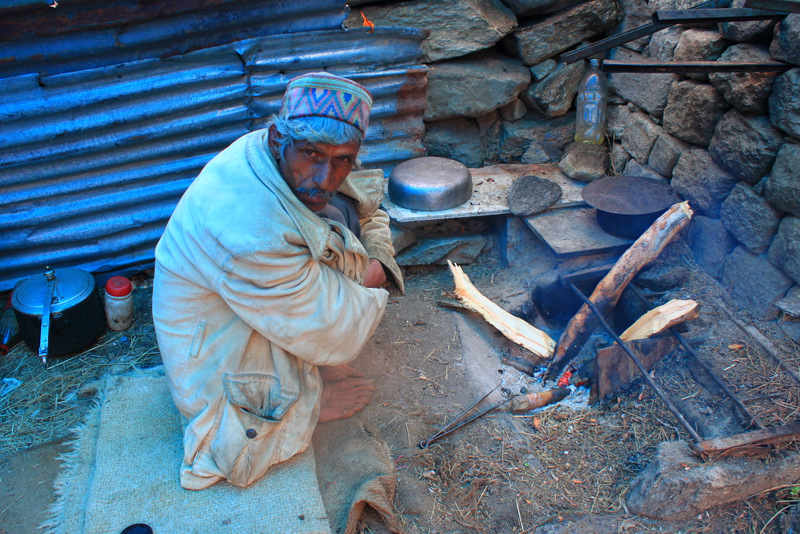
After three hours of solid trekking we spot people clambering over a huge boulder spanning a stream — the Mini Pandav Bridge. The group crossing it is one Keval said had not returned for four days. I ask the porter about conditions ahead. “It is a misery. There was almost four feet of snow at Mantalai and we were almost dead.” There was a dull fear in his eyes.
Saad and I cross carefully, maintaining our balance while finding tiny footholds. It is a short-lived celebration — the big brother is around the corner: the Pandav Pull.
This “bridge” is a boulder so enormous it spans almost the entire 30-foot width of the Parvati River. Almost — the remaining distance is closed by a series of small stones, creating a staircase shape since the boulder abruptly ends 20 feet above the water surface. When you climb up and look down this rock, it feels like standing atop a three-storey building. What intimidates you most is not the crossing itself but the sheer impossibility of how this thing came to rest here. Maybe, during the last ice age, a boulder broken from a mountain was dragged by a glacier to its present site. Today, those glaciers have retreated inland and the U-shaped valleys they carved have been worked into V-shapes by thousands of years of river erosion.
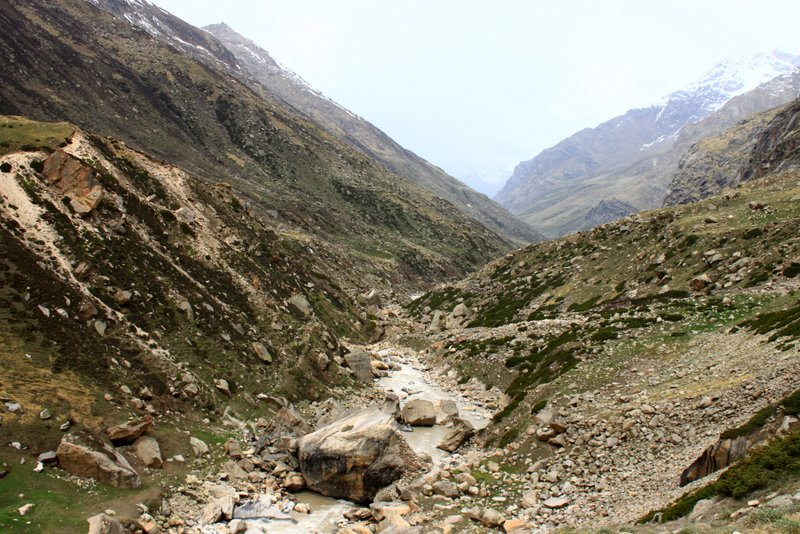
The Pandav Pull can be seen at the bottom, blocking the flow of the Parvati.
We are tired after this ordeal — not physically but mentally. It has taken us close to 45 minutes to cross both bridges. The time is 12:30 PM.
The nearest camping place after Pandav Pull is Tunda Bhuj — a wide expanse of open meadows, some two hours ahead. Crossing the moraines that lie between us and it is one of the worst pranks nature can play on you. This undulating landscape is an endless series of crests and troughs. Imagine descending and climbing a flight of stairs forty times and gaining nothing in altitude for a kilometre of travel. “Who the hell wanted to do this trek anyway,” I mutter vehemently.
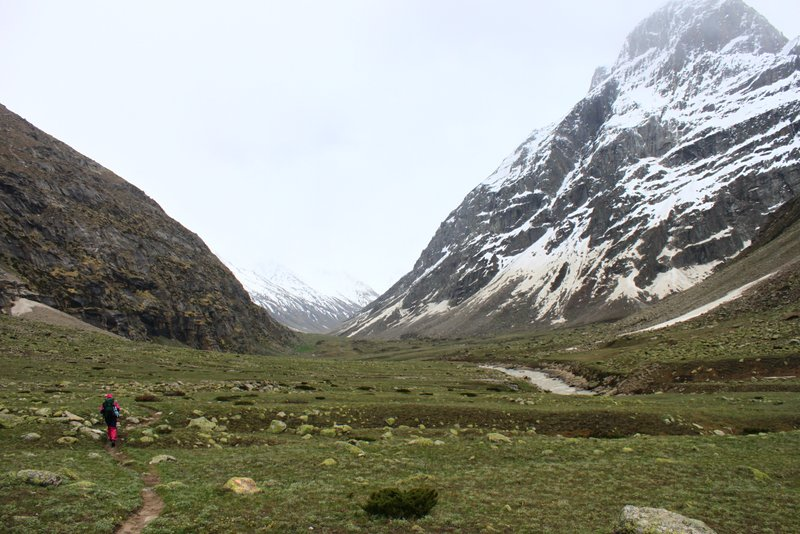
Entering wide open meadows and seeing the U-shaped valley
Further ahead, Saad collapses. “No more,” he gasps. I tread a bit further and luckily find a camping spot — burnt-out garbage confirms others have been here before. The exhaustion has taken such a toll that the usually happy time we have fixing the tent is filled with taunts. The brutal cold wind erodes our joy. Once inside, wrapped in sleeping bags, we return to jolly senses.
We analyse the food supply: ready-to-eat packets, dry fruits, cheese, jam and cornflakes. Ought to be enough. Saad returns from the river with a bottle of muddy water — apparently no clear streams here. The food, from the moment it enters the mouth to just before it leaves the alimentary canal, is so gratifying we throw multitudes of praise at the brand name. The foul taunts of an hour ago have evaporated, replaced by nice pleasantries.
We are extremely proud of having trekked beyond our planned destination and eagerly await the last leg to Mantalai.
Day 8 — Towards Mantalai
The weather gods are not pleased with our presence. 5 AM, temperature at 1°C, and rain. I watch in slow agony as raindrops pour relentlessly over our tent, forming tiny streams on their way down.
After a serious discussion we make our decision: we have come this far, and we will go to Mantalai. Our bags will stay in the tent. I forgo my camera. We stuff biscuits, dry fruits and muesli into our pockets.
Both of us are a bit delirious. The insomniac river runs nonchalantly to our right. The black mountains are adorned with patches of old snow. Some snow appears near the river and Saad wanders towards it like greeting a long-lost friend. The rain reduces to a drizzle.
We reach a wide open plain where the river now moves in long, lazy circuitous paths — splitting here and there but joining later on. The trail vanishes and the soil oozes water underfoot. This plain ends and we’re back to undulating landscape, with the mountains closing in. Far away, glaciers painfully rumble down the slopes. The drizzle becomes light snowfall. We are elated.
And then our worst fears come alive. The trail ends abruptly. Saad begins his reconnaissance. The U-shaped area ahead is scarred with grey rocks and nearly devoid of vegetation — as if someone had scooped a large portion of the mountain and sucked all the life it ever had. Saad spots a cleft and we descend into this absolutely barren landscape.
Something does not look good. It is much steeper than we anticipated. Everything around us looks freakishly fragile. The only conversation we have is uttering words of caution. Saad leads, crawling down the slope, and then emits a gasp of terror. He shouts back that everything is crumbling and he cannot find a handhold. I grab a boulder next to me — it collapses into my hands.
Moving achingly on his back, Saad finally reaches the end of this slope, which drops another 20 feet before continuing. I scout the west side for an opening to lower ground. The surface is littered with trillions of small crushed stones — underfoot, they constantly shift and slide, so instead of moving forward you slip backwards. On the way up, Saad makes an urgent decision: he removes his backpack and throws it down. Without that weight dragging him back, he climbs up to safety.
I begin my own climb. The next rock I grab fails me completely. I slide down some distance before using my feet to find friction and grab another rock. I look up toward Saad. We both know it was a miss. I inspect the silvery rock in front of me — it is layered and also on the verge of collapse. I cannot use it. My boots are deep in the powdery surface and every attempt to lift and move them drags me further down. There are no rocks nearby. I am stuck.
Minutes pass into oblivion and my mind loses hope. The fear that had lurched behind my wall of confidence and concentration crashes through. I feel insecure of the minuscule of my existence. I want to weep but tears don’t come. My teary cries of ‘Saad’ are futile — he looks terrified as well. He is just too far away to risk coming to help.
What comes next is unanticipated. I feel an ease to let go. My heart pounds so excitingly that I feel I cannot breathe. It is a weird sort of pleasure to let gravity take over — to plummet 150 feet into the river below and die. All the years of existence, the thought of the future and the wonderful dreams of life would be gone in an instant. As a final gesture, I look deep into Saad’s eyes, recite a silent goodbye and thank him for being a friend. Never have I said more words with a glance.
But just then — as if my brain has opened a new back door — images and words erupt. Adventure. Bear Grylls. The magnanimity of the world at large. I take some quick jumps as rocks fall before me. I am absolutely, completely concentrated at the task at hand. I reach safety and hear the sounds of elation and encouragement from Saad.